
Our children are our most valuable resources, yet their health and that of their families and communities have not been at the forefront of our nation’s policies and programs.
Use the Voter Guide, along with the Companion Voter Toolkit, to assess your candidates local, state, and federal candidates to make sure they’re keeping children at the center of their decisions.
A disregard for environmental public health and equity has very real and significant social, economic, and security implications for our nation’s future.
We can and will get there.
Help build a better future by exercising your right to vote and make sure to #Vote4Kids.
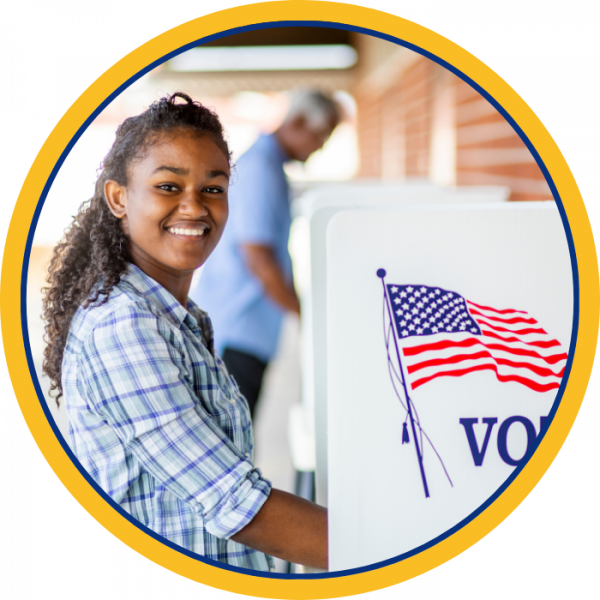
Our country was founded on democratic ideals. The expansion of these ideals and rights to all citizens is ongoing, and vigilance is needed to preserve and build upon this progress.
Additionally, we must uphold our constitutional concepts of Federalism and Separation of Powers to prevent a slide from democracy into tyranny.
Children experience higher rates of poverty than adults in the United States and often need greater support to access health care, as nearly half of all children rely on Medicaid. Children’s health is also shaped by the conditions in which they live, learn, and play.
This includes access to affordable housing, quality child care, safe communities, essential resources, and access to green and blue spaces. Black, brown, and Indigenous children and those living in under-resourced communities face the greatest barriers to access these healthy living conditions due to longstanding inequities.

Children are especially vulnerable to the negative impacts of climate change. Those most at risk include children of color, those living in poverty, those with pre-existing illness or disability, infants, and pregnant women.
Approximately 35 million children in the U.S. live in counties with unhealthy levels of air pollution. Of these children, approximately 2.5 million have asthma.

Many children in the U.S. drink contaminated water, whether from public systems or private wells. Contaminants may include disease-causing bacteria such as E. coli, neurotoxic metals such as lead, and carcinogens such as PFAS (“forever chemicals”).
Children in the U.S. are exposed to thousands of chemicals every day through food, drinking water, air pollution, building materials, furnishings, and consumer products. Of the over 86,000 chemicals in use in the U.S., many can be found in toys and everyday products, and most are untested for safety.
Pesticides and toxic chemicals such as PFAS (“forever chemicals”), volatile organic compounds, and phthalates, are associated with a number of children’s health concerns, including childhood cancer which has increased by 41% since the 1970s.
U.S. production and technological advancements should not come at the expense of the well-being of children and their families. Corporations with large industrial bases or technological data centers must minimize their hazardous emissions, resource consumption, and carbon footprint to reduce risk to the environment and to communities.
Polluting and extractive industries are often sited in rural areas and areas of lower wealth and communities of color.The children and their families in these communities pay with their health.
Protecting children’s health requires a foundation built on and continuously informed by rigorous research findings, and the courage to act on them. To achieve this, we must sustain and strengthen our nation’s scientific infrastructure and capacity. Cutting federal research programs, freezing grants, silencing or dismissing scientists, and undermining public trust in established science endangers children’s health.
Pesticides and toxic chemicals such as PFAS (“forever chemicals”), volatile organic compounds, and phthalates, are associated with a number of children’s health concerns, including childhood cancer which has increased by 41% since the 1970s.

Provide feedback on the Voter Guide and Companion Toolkit in this two-minute survey.
Confirm your voting eligibility, register to vote, check your voting deadlines and requirements, and make a plan to vote for kids.
Put the Voter Guide into action using the following practical, step-by-step guidance to help you evaluate candidates’ records, policy positions, and commitments.